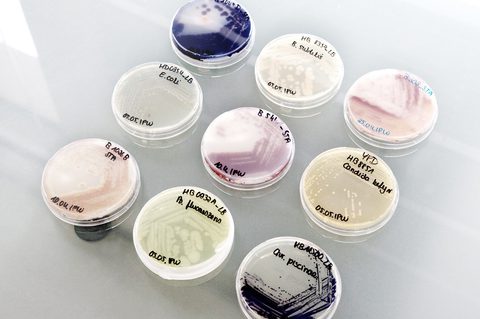
Biomolecule Production Strains
Combining microbial diversity with advanced strain and enzyme engineering for the production of valuable biomolecules.
What's in for you?
- Find the right strain for your target biomolecule and production process
- Increase yield and performance with access to a powerful genetic engineering toolbox
- Reduce development risk with solutions designed for scalable industrial manufacturing
- Build a reliable solution with unique, traceable, and Nagoya-compliant strains
Our BioArchive: Unlocking microbial potential for industrial manufacturing
Start with the right microorganism. Our BioArchive is an industrial strain collection that gives access to unique microorganisms providing a powerful foundation for the development of efficient, high-performing biomolecule production strains.
We have successfully built production strains from parental strains across a wide range of bacterial, yeast and fungal genera, including Bacillus, Corynebacterium, Pseudomonas, Cupriavidus, Serratia, Escherichia, Streptomyces, Saccharomyces, Talaromyces, Phaffia, Yarrowia, Kluyveromyces, Ustilago and Aspergillus.
BioArchive strains are compiled to support commercial use. They are compliant with Nagoya Protocol requirements, pre-characterized and traceable through documented origin of isolation. This helps reduce development risk and creates a reliable path from strain selection to industrial manufacturing.

“By combining the diversity of the BioArchive with advanced strain and enzyme engineering, we help you develop differentiated production strains designed for industrial success.
We enhance strain performance by replacing key pathway enzymes or integrating additional enzymatic functions. Our MetXtra™ technology platform identifies novel enzymes that can
- increase productivity and process performance,
- enable the biosynthesis of specialized biomolecules,
- open new pathway-engineering opportunities,
- and support freedom to operate in commercial applications.
By combining the diversity of the BioArchive with advanced strain and enzyme engineering, we help you develop differentiated production strains designed for industrial success.
Biomolecule production strain development
Your development program can begin with a parental strain from the BioArchive or with your own strain, which you can transfer to our laboratories to be optimized for your application. Our streamlined development process comprises four key stages:
- Selection of a suitable parental strain
- Establishment of strain-specific genetic-engineering methods
- Integration of key enzymes and pathway functions
- Systematic fine-tuning of metabolic pathways
We continuously expand and adapt our genetic-engineering toolbox to new microbial species and strains. Depending on the organism and development objective, we combine established methods including conjugation and allelic exchange with advanced CRISPR technologies for precise, marker-free genome editing.
Our proprietary CRISPR-BMC genome-editing platform is applicable across bacteria, yeasts and filamentous fungi.
We continuously onboard additional strains, enabling faster and more efficient gene integration, gene deletion, and targeted gene modification. We also analyze regulatory networks and metabolic pathways to identify bottlenecks and optimize cellular performance systematically.
The engineering strategy is tailored to your organism, target biomolecule and intended application using recombinant or non-GMO development routes to meet your specific requirements. Targeted genetic engineering can be complemented by classical strain-improvement methods.
Our smart adaptive laboratory evolution (ALE) and random mutagenesis technologies help optimize strain performance and address complex production challenges.
Achieving industrially relevant product yields requires more than individual genetic modifications.
Interdisciplinary approach
Our strain-development experts work closely with specialists in microbiology, enzyme technology, bioinformatics, analytics and bioprocess development. This interdisciplinary approach keeps every project focused, efficient and aligned with the requirements of industrial manufacturing.
