Case study: Efficient Bioprocess Design Drives Enzyme Development for Pharmaceutical Applications
Producing CRISPR nucleases as ribonucleoproteins (RNPs) for genome editing requires highly efficient production and exceptionally pure enzymes. We developed a scalable bioprocess that doubled production yield while delivering >95% purity.
Key outcomes
- 100% Increase in production yield
- 95% Enzyme purity
- Scalable fermentation process from 2 L to 10 L
- Multi-step purification process suitable for commercial manufacturing
- Pharmaceutical-grade CRISPR nucleases for RNP applications
The customer challenge
Our customer required highly purified CRISPR nucleases for use as ribonucleoproteins (RNPs) in pharmaceutical genome-editing applications.
Unlike plasmid-based delivery, RNP-mediated CRISPR editing provides immediate activity and can reduce unwanted genomic effects. However, producing these enzymes at commercial scale presents significant challenges.
CRISPR nucleases naturally bind DNA and RNA with high affinity, making purification difficult and increasing the risk of nucleic acid contamination. For our application, it was crucial to eliminate these unwanted interactions, ensuring the nuclease remained completely free of nucleic acids for precise loading in its intended use. Commercially available nucleases were not an option, as the final product needed to be entirely nuclease-free.
Our solution
We developed an integrated upstream and downstream process that combined microbial strain optimization, fermentation development and multi-step purification into a scalable manufacturing workflow.
Bioprocess development
Using our expertise in microbial expression technology, we selected the optimal Escherichia coli production strain, expression cassette and plasmid design to establish an efficient production system.
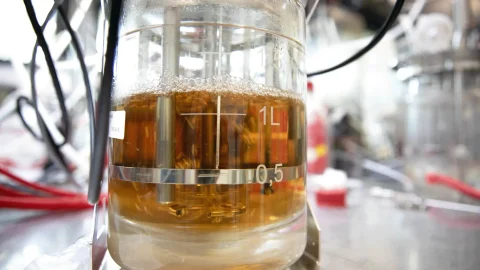
Following successful small-scale expression, the process was transferred to bioreactors for systematic optimization. Key fermentation parameters, including temperature, pH, induction strategy and feed composition, were refined across fermentation scales from 2 L to 10 L.
These improvements resulted in a 100% increase in nuclease production yield.
“This successful project relied on interdisciplinary collaboration which is one of our strengths. Microbial strain and bioprocess development as well as analytics - driven by scientific exchange and a shared goal.
Downstream Processing
The greatest challenge during purification was the enzyme's intrinsic affinity for DNA and RNA. To overcome this, we implemented a data-driven optimization strategy using Design of Experiments (DoE):
- We optimized flocculation to maximize DNA removal.
- We developed a second DoE-based precipitation step to remove residual flocculation agents.
- We refined buffer conditions to improve enzyme solubility while enabling high product concentrations.
This integrated purification strategy effectively eliminated nucleic acid contamination while maintaining enzyme activity throughout the process.
Results
The project resulted in a robust, scalable and commercially viable manufacturing process for CRISPR nucleases.

How we found an alternative genome-editing platform for engineering industrial strains
This case study shows how we took a holistic approach and combined technologies to provide a more efficient enzyme tailored to the needs of a specific industrial application.
Side streams can be transformed into innovative products: An example from the wine industry

Accelerate enzyme discovery with the MetXtra™ technology platform and pave the way for your breakthrough in industrial biocatalysis
It can be difficult to produce CRISPR nucleases for use as RNPs. This case study demonstrates how we found a solution.
Finding the right enzyme quickly with our directed enzyme panels.
When every stage of enzyme development is connected, innovation moves faster, risks are reduced, and better outcomes become possible.
An enzyme engineered version of BRAIN Biotech´s CRISPR-BMC with superior properties in yeasts accelerates development of high-performance strains.


Quickly assess whether Aspergillus niger is the right production host